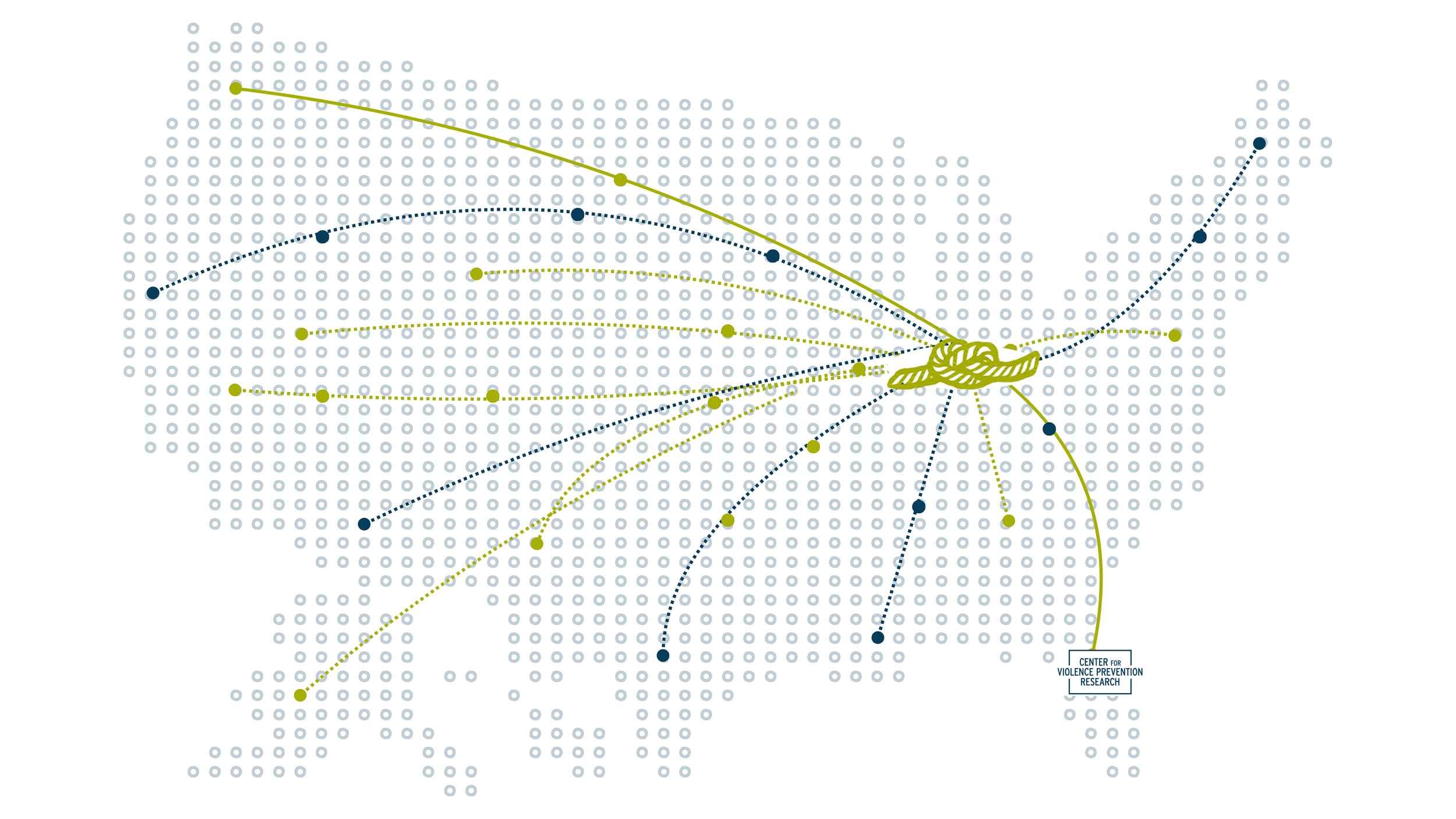
Thousands of schools across the U.S. are required to teach child abuse prevention, but until recently, nobody could say which students were actually getting it. A new data platform from kNot Today, developed in collaboration with the Center, is fixing that.
8 min read
When she was 16, Jenna Quinn told her older sister that she had been sexually abused since she was 12 by a close family friend. When her mother took her to the hospital in their native Texas for a forensic medical exam, Jenna’s mom picked up a brochure that detailed how to spot the signs that a child might have been sexually abused. Her mother, a teacher, was furious. Why was she getting this information after the fact? Why wasn’t anyone teaching this?
Jenna Quinn has since become an advocate for child sexual abuse prevention education. In 2009, Texas passed Jenna’s Law, which required public schools to teach students, staff, and parents how to recognize and respond to child sexual abuse. It was the first such law in the country named after a survivor, and more than half of all states have since adopted some version of it.
In 2016, Tammy Lampert, the executive director of the Southwestern Indiana Child Advocacy Center Coalition, asked Quinn to come and speak to a crowd of local students and child-abuse professionals. During that visit, Quinn asked her what Indiana required schools to teach. Lampert had no idea. “I’m the executive director of a CAC,” Lampert told us. “I should probably know that.”
Lampert got to work. She discovered that Indiana’s legislation, passed in 2012, was more of a suggestion. It encouraged schools to teach prevention to students, but it wasn’t a requirement. It was also limited in scope, covering only children in grades two through five. A mentor suggested she speak to two women in Indianapolis to help her strengthen the law. So she drove up, sat down with them, and started going through everything that was wrong with Indiana’s approach.
“If you don’t say it has to be done, then why would they do it?... It’s just another thing”
“I said, ‘This is the most asinine thing I’ve read,’” she recalled. “‘What, kids don’t get abused before kindergarten? And it stops at fifth grade?’”
It turned out that the two women were the ones who helped to draft the initial legislation. Luckily for Lampert, they agreed, telling her that it was the best that could be done at the time. But now it had been four years, and the legislation was overdue for an update. Lampert started making calls, including one to State Senator Mark Messmer, who agreed to author a replacement: Senate Bill 355. But the early drafts were lacking. Though they expanded the ages to cover every student from kindergarten through 12th grade, they said schools could teach prevention, not that they had to. It was the same mealy-mouthed approach as the 2012 version, meaning that already overburdened schools could easily overlook it. “If you don’t say it has to be done, then why would they do it?” said Lampert. “It’s just another thing.”
She went to bat and won. The bill’s “could” became a “shall,” and the bill passed both chambers. Governor Eric Holcomb signed it in April 2017. From that point forward, every school in Indiana, public or private, had to provide age-appropriate instruction on child abuse and sexual abuse prevention every year. Indiana now had a mandate. What it didn’t have was money to carry it out, or any way of knowing whether anyone was following it—two gaps that researchers have identified as problems with similar laws across the country.
Emma Marsh made closing those gaps her mission. Marsh is the executive director of kNot Today, an Indianapolis nonprofit focused on preventing child sexual abuse. Soon after she joined in 2021, she began hearing firsthand from people struggling to carry out Senate Bill 355. They needed help. kNot Today had been looking for a focus, and this was it. Every organization teaching prevention in Indiana’s schools was trying, on its own, to figure out which schools were getting this instruction and which weren’t. Marsh’s response was to get those organizations in the same room. This group became the Indiana Prevention Education Coalition and, starting with the 2021–22 school year, members began reporting how many students they reached. For the next few years, the data came in, and the team at the Center for Violence Prevention Research started to compile them in a spreadsheet. Then, in the summer of 2024, at the coalition’s in-person gathering, kNot Today gave members access to the full spreadsheet for the first time and asked them to find the gaps in their regions.
“It was kind of a mess,” said Marsh. “This spreadsheet was 92 tabs long, and although we had data in front of us, we couldn't make sense of it in that form. It wasn't exactly the solution to our problem.”
That gathering was the turning point. The data had to be usable, Marsh and Dr. Melissa Bright, CEO and Chief Science Officer of the Center, agreed. Before building anything, Marsh looked for a model, checking whether other states and organizations had found a better way to track prevention education. She didn’t find one that fit. So, much like Lampert’s push to improve the legislation, Marsh and her team at kNot Today decided to build it themselves. The result was The Bridge, a platform built to track child sexual abuse prevention work across the U.S., which launched in January of 2026. It covers six kinds of prevention: adult education, child and youth education, child safeguarding policies, legislative advocacy, perpetration prevention, and awareness activities.
For the school-based prevention education component, coalition members—the nonprofits and child advocacy centers that teach the lessons—log each school and grade they reach and which program they used. For the first time, the coalition can see in one place which Indiana schools are getting the prevention education the law requires, and which aren’t. While nobody is required to use The Bridge, and getting people onto it was the team’s biggest worry, the uptake has been promising. Marsh credits the support of the coalition, plus a little money: organizations that submit data for six months get a small stipend, and that makes them eligible for larger grants. “Every week, people are on the platform submitting their data,” she said.
But having the data in one place is just the beginning. Data are only as reliable as the people entering them, and that’s where the Center for Violence Prevention Research comes in. As kNot Today’s research partner, the Center loaded those three years of hand-entered spreadsheet data into the platform. Along the way, the Center learned how error-prone that approach had been. Much of its own earlier data turned out to be wrong because of entry mistakes.
Those mistakes weren’t unique to the Center. The Center now analyzes what comes out of The Bridge, and its first review turned up the problems you’d expect when people with different systems enter their data in a shared space: some schools and grades were reported twice, and some showed more students reached than were enrolled. Others came from the platform itself. Without standardized definitions, numbers couldn’t be compared across organizations, and when an optional question was left blank, there was no way to tell whether someone skipped it, misunderstood it, or missed it, so the whole question had to be thrown out.
“The Bridge gives the field the infrastructure to not only measure prevention, but also links prevention data to outcome data in a way that has never been done before.”
Fixes are already in place. Organizations now have to name the program they delivered, and they can no longer enter the same program twice for the same school, grade, and year. In January 2027, the Center will check this year’s data to see how the changes are working.
“We can’t know if prevention works if we can’t measure it,” said Dr. Bright. “The Bridge gives the field the infrastructure to not only measure prevention, but also links prevention data to outcome data in a way that has never been done before.”
Public health already has a model for this. When cases of COVID-19 or sexually transmitted infections are diagnosed, they’re reported to health departments, which track where cases are rising so they can direct testing, treatment, and outreach where they’re needed most. The Bridge applies the same logic to school-based prevention programming. The difference is that instead of tracking where harm is occurring, it tracks where prevention is reaching, so the field can see which schools are being missed and target help there. Eventually, these data will be compared with sexual abuse prevalence rates to help understand whether the programs are having the desired effect.
That kind of system is familiar territory for Dr. Alli Ertl, the Center’s senior data analyst, who is leading the Center’s work to help design The Bridge’s backend. Before joining the Center, she spent years as an epidemiologist at the Centers for Disease Control and Prevention, building and running public health surveillance systems. She worked on the National Violent Death Reporting System, which tracks violent deaths across the U.S., and helped launch a new national surveillance system for syringe services programs. During the COVID-19 response, she led the team that delivered validated daily case and death counts to the CDC director. She also directed national viral hepatitis surveillance and oversaw traveler health surveillance across 22 U.S. ports of entry. Now she’s turning that expertise toward primary prevention, helping to build a system that tracks not who has been harmed, but who has been reached.
Indiana and North Carolina are two states currently using The Bridge. When Marsh and Dr. Bright attended the Prevent Together annual meeting in Salt Lake City in September, at least three other states expressed interest in taking part. Marsh’s long-term goal is that all 50 states sign up so that they have some way to measure which organizations are providing which prevention services and where, across all six areas the platform tracks, and whether that work is making a difference.
The research behind this story
This story draws on two studies by Center scientists, including one under review.
Forthcoming
Conducting Statewide Surveillance of Child Sexual Abuse Prevention Education Implementation: A Proof-of-Concept Study
Under review. We'll add the full article when it's published.
Can't access a paper? We'll share it.
Tammy Lampert, who helped push the legislation through in Indiana, is confident that prevention education in schools works. Over her career, she has conducted more than 1,600 forensic interviews with children who have experienced abuse, and says she has noticed a shift since Senate Bill 355 was enacted. Children now tell her that they learned at school that what was happening to them wasn’t okay, and went home and told someone. One young girl, in particular, stands out.
“The abuse had been happening her whole life,” said Lampert. “When she was in third or fourth grade, she was finally at school for the prevention lessons. We looked back at her attendance records, and she’d been absent for them every year before. The guardian who was abusing her knew when they were coming and kept her away. They kept that education from her for three or four years. Then she finally heard it, and she told that same day.”
KEEP READING